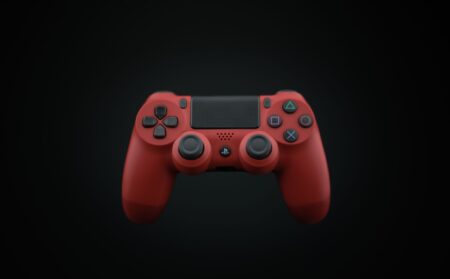




Arcade manufacturers are discovering that PlayStation 5’s DualSense controllers offer more than just console gaming benefits. The haptic feedback technology and adaptive triggers that made waves in living rooms are now finding their way into commercial arcade cabinets, creating new possibilities for immersive gameplay experiences that traditional arcade sticks and buttons simply cannot match.
Several cabinet builders have begun incorporating DualSense controllers into custom arcade setups, particularly for racing simulators and combat games where the controller’s advanced vibration patterns and trigger resistance can enhance the physical connection between player and game. The shift represents a departure from decades of standardized arcade inputs, driven by the controller’s ability to simulate everything from engine vibrations to weapon recoil with remarkable precision.

Racing Simulators Lead the Charge
Racing arcade cabinets equipped with DualSense controllers are delivering tactile experiences that surpass traditional force feedback wheels in some applications. The haptic motors can simulate road texture, tire slip, and collision impacts through the controller body rather than relying solely on steering wheel vibration. Players report feeling different surface materials – gravel, asphalt, grass – transmitted through their hands with surprising accuracy.
The adaptive triggers add another layer of realism to braking and acceleration. As players press the trigger deeper, the resistance increases to mimic the feel of actual brake pedal pressure or throttle response. This creates a more intuitive connection between input pressure and vehicle behavior, eliminating the binary on-off sensation of traditional arcade buttons.
Some racing cabinet installations are pairing DualSense controllers with simplified wheel assemblies, allowing the controller to handle fine-detail feedback while the wheel provides gross motor steering input. This hybrid approach combines the familiarity of wheel-based controls with the nuanced feedback that only the DualSense technology can provide.
Fighting Game Applications
Combat-focused arcade games present different opportunities for DualSense integration. The haptic feedback can distinguish between different types of hits, blocks, and special moves through unique vibration signatures that players learn to recognize. Each character’s attacks can feel distinctly different through the controller, adding a tactile element to competitive play.
The adaptive triggers work particularly well for games featuring charged attacks or variable-strength moves. Players can feel the tension building as they hold a trigger to power up an attack, with the resistance increasing to signal maximum charge. This eliminates guesswork and creates a more intuitive timing mechanism for complex combat sequences.
Technical Integration Challenges
Implementing DualSense controllers in arcade cabinets requires custom interface boards that can communicate with the controller’s advanced features while routing signals to arcade-standard hardware. Traditional arcade systems expect simple digital inputs, but the DualSense provides analog data streams for haptic feedback, trigger resistance, and motion sensing that must be translated for older game engines.
Cabinet builders are developing proprietary solutions to bridge this gap, creating hardware that can interpret DualSense data and convert it into formats that arcade motherboards can process. The challenge lies in maintaining the controller’s advanced features while ensuring compatibility with existing arcade game software that was never designed to handle such complex input devices.
Power management becomes another consideration, as DualSense controllers require more electricity than traditional arcade controls. Cabinet builders must account for battery charging systems or hardwired power solutions that can keep multiple controllers operational during extended play sessions. Some installations are experimenting with quick-swap battery systems that allow dead controllers to be replaced without interrupting gameplay.
The durability question remains largely unanswered, as DualSense controllers were designed for home use rather than the constant abuse of commercial arcade environments. Early installations are closely monitoring controller lifespan and failure rates to determine whether the enhanced gameplay experience justifies the increased maintenance costs and replacement frequency compared to traditional arcade controls.